Our detailed survey identifies the following materials:
- Asbestos
- Lead in Paint
- Synthetic Mineral Fibre
- Polychlorinated Biphenyls
Organise an asbestos survey today
An asbestos and hazardous materials survey is a necessary document for any construction project. Avoid delays by choosing a trusted name in the asbestos removal industry. Airsafe have more than 35 years of industry experience and will get the job done right, every time. If you’re in a rush, we can often get an asbestos consultant on site within hours. Just call us today on 1300 888 338.
Our Asbestos survey process
A typical asbestos survey with Airsafe goes like this:
- Fill in our quote request form.
- Our consultant will examine your details and provide a quote.
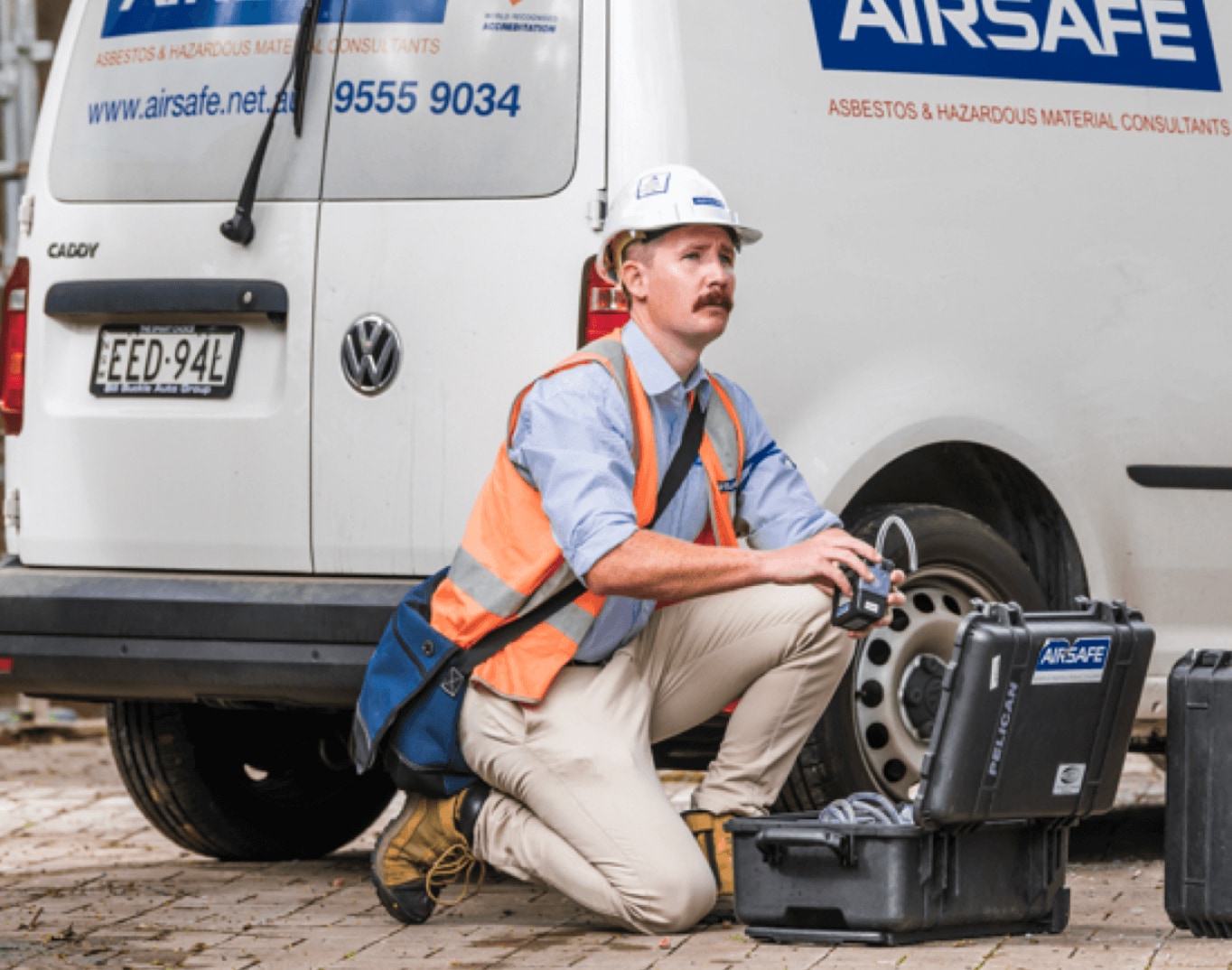
- One of our fleet of inspection vehicles will be dispatched to your location, anywhere in Sydney.
- Specialist consultants will take samples for testing in our NATA-Accredited lab.
- The location, extent, and condition of asbestos materials is determined.
Asbestos survey reports
At the end of Airsafe’s asbestos survey, you’ll receive a comprehensive survey report which will contain:
- An easy-to-read Executive Summary of key findings and recommendations
- An outline of what the survey consisted of and the methodology used
- General information about asbestos
- A legally compliant Asbestos Register for the site
- A detailed list of recommendations
- Photographs of areas where asbestos was found, for easy identification
- Laboratory reports showing results of asbestos testing
All asbestos survey reports are not the same
Since 1988, Airsafe has built a reputation within the asbestos industry. We’ve completed asbestos and hazardous materials surveys at hospitals including Royal Prince Alfred, Prince of Wales, Prince Henry, Gladesville and Sutherland, council building portfolios for Blue Mountains, Wollongong, Sutherland and Ku-ring-gai, every university in NSW, BHP sites at Port Kembla and Newcastle, and Defence sites including Duntroon, Russell Offices, Garden Island and Holsworthy. We work regularly with Sydney’s largest commercial builders including Multiplex, Lend Lease and Built, and major government departments including Sydney Water, NSW Education and Sydney Trains. Our survey reports are accepted as definitive by SafeWork, local councils, and other authorities.
Recent flagship work includes the Sydney Metro West Eastern Tunnelling Package for Mann Group under the John Holland CPB Ghella Joint Venture – one of the biggest combined asbestos and occupational hygiene jobs undertaken in Sydney, with around nine CBD buildings demolished on Pitt and Hunter Streets and Airsafe working across the wider Metro program. Airsafe completed the asbestos and hazardous materials audits, ran two consultants and an on-site lab for the roughly twelve-month duration, and provided a dedicated occupational hygienist managing dust, gas and hygiene monitoring throughout the works.
We don’t cut corners on our surveys. Because Airsafe owns and operates its own NATA-accredited laboratory in-house, we don’t carry the per-sample cost pressure that pushes outsourcing consultants to limit their sampling. We’ll test as many samples as we need to until we’re satisfied that we have a complete picture of your building’s asbestos containing materials.
Don’t take chances with something as serious as asbestos.
Sydney-based, Australia-wide
Airsafe is based in Sydney and works Australia-wide. Our consultants have run surveys from Perth to Darwin and at remote sites across the country – on government, mining, ADF, hospital, school and major commercial developments. Travel is built into our quotes for interstate work, so what you see is what you pay.
Adherence to asbestos legislation
Asbestos Inspectors are recommended by SafeWork and approved by local councils. Our asbestos inspection reports are produced in accordance with the requirements of the NSW Work Health and Safety Regulation.
Because of Airsafe’s experience and reputation, our survey reports carry real weight and authority. A report from Airsafe is regarded throughout the construction industry as proof that you’ve carried out due diligence around hazardous building materials like asbestos.
Asbestos surveys and asbestos registers
Increased awareness and public concern in relation to asbestos has highlighted the need for businesses to be on top of their Work Health and Safety requirements. According to these conditions, all building owners in premises built up to 31 December 2003 must have an asbestos register completed to comply with regulations.
While the Acts, Regulations and Codes of Practice do vary in each state and territory, it is mandatory for all commercial properties to have an up-to-date Asbestos Register on the premises. Simply put, the asbestos register will list all the asbestos that is known to be in your workplace.
The best way for your business to complete a legally compliant Asbestos Register is to work with a company accredited for their asbestos expertise. Airsafe has two major forms of accreditation: seven of our consultants are Licensed Asbestos Assessors, and as a company we’re accredited by NATA, the National Association of Testing Authorities, for asbestos identification and fibre counting (NATA accreditation No. 2959).
Detailed expert inspection: The core of an asbestos survey
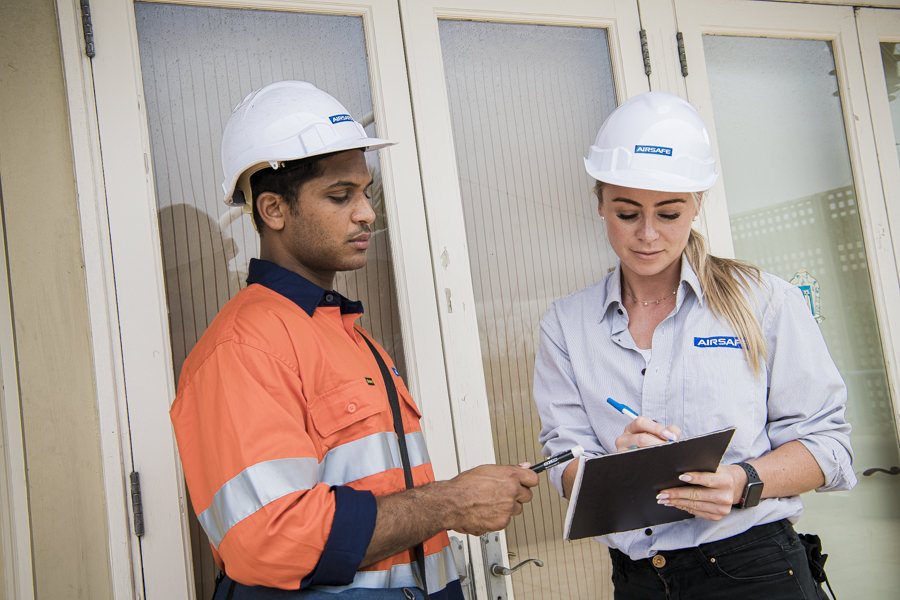
The most important component of an Airsafe asbestos and hazardous materials survey or audit is a close inspection of your premises, by a trained and experienced asbestos consultant who knows what to look for.
At Airsafe, our team of consultants can help your business:
- identify suspected asbestos materials and determine their level of risk
- determine where asbestos is likely to be present
- determine which materials may be friable or non-friable and evaluate its condition.
Your Airsafe consultant will conduct a thorough inspection of all buildings and structures, one that includes all rooms, ceiling spaces, cellars, shafts, storage and wall cavities. To err on the side of caution, we treat any suspect material as containing asbestos until we ascertain otherwise.
The Airsafe consultant will take notes and photographs throughout your inspection. These will come in handy when it comes time for us to complete your workplace’s asbestos register.
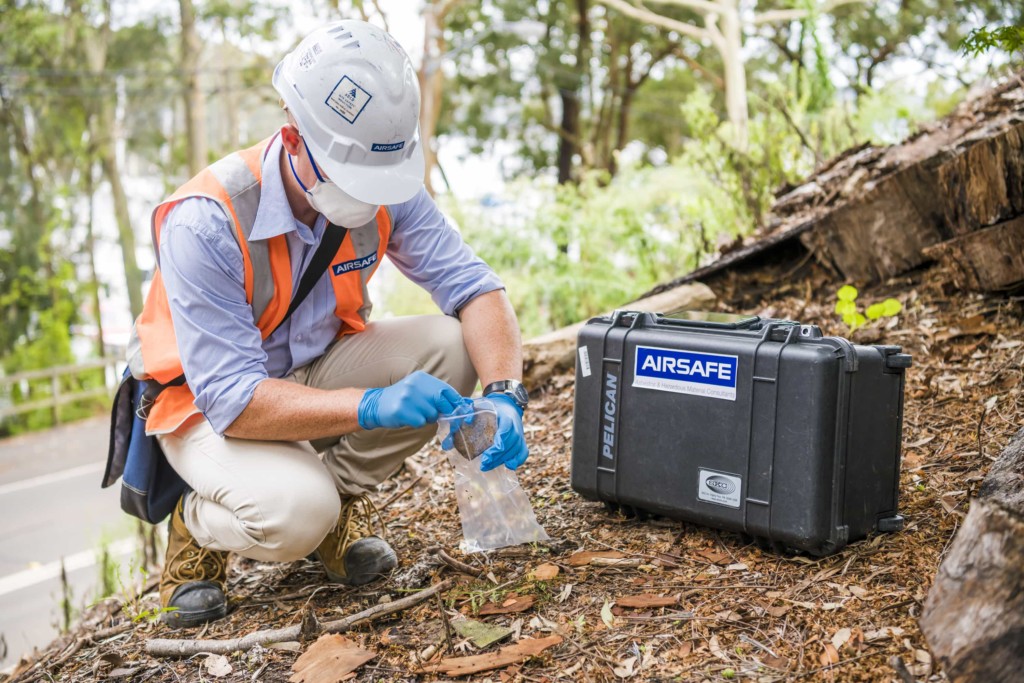
Asbestos testing of samples taken during the survey
If you suspect that a material in your workplace could be asbestos, it’s important to get it tested. If a sample is taken for the purpose of determining if asbestos is present, it is important that representative samples are taken. For instance, if there are variations in appearance, texture or colour of the material, we will need to take additional samples to ensure consistency and a valid analysis.
We will test for asbestos in any material that:
- can’t be identified
- can’t be accessed and is likely to contain asbestos (for example, this is often the case with downpipes)
- we can’t be sure does not contain asbestos.
Under the NSW Work Health and Safety Regulation, only accredited laboratories are approved to analyse samples containing asbestos.
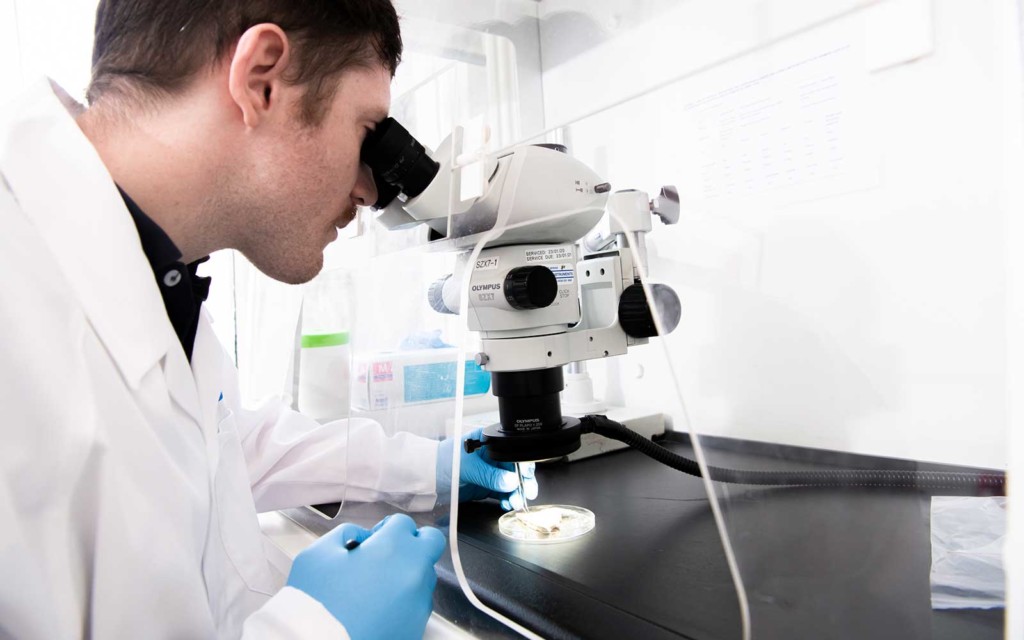
At Airsafe, we have our own state-of-the-art laboratory where we analyse samples in full detail using a rigorous process and advanced testing methods using Polarised Light Microscopy (PLM) and Dispersion Staining (DS).
Using a NATA accredited laboratory is a requirement of the Work Health and Safety Regulation, and it’s what makes a result rigorous and independent. You can check any provider’s accreditation, and its scope, at the NATA website, and a genuine report will always name the laboratory that carried out the analysis. Here’s what to look for in a report.
Testing for lead and other hazardous materials
As well as asbestos, we also test for a range of hazardous materials, especially lead and heavy metals.
We’ve greatly reduced turnaround time for this testing by using XRF Analysers – equipment that allows us to reliably determine the chemical composition of a sample on site, without causing damage or waiting for laboratory testing.
This means that if we find material that we suspect contains lead or other hazardous materials, your survey results won’t be held up waiting for test results.
4.9 stars across 600+ Google reviews – from builders, developers, councils and government across NSW and beyond.
“Airsafe was very helpful. They produced well written reports very quickly. They are also very flexible. In our case, we had an urgent request for asbestos inspection and quantification. It was a very organised process that was resolved within the week. Communication was simple and easy with both admin staff and the site inspector. Would highly recommend this company.”– Steffie Arsenis, December 2023
“We had a fantastic experience with AirSafe! They handled the asbestos compliance notice at our property with the highest level of professionalism. The team was efficient, thorough, and kept us informed throughout the entire process. They even went above and beyond by contacting the council directly to clarify certain matters, which gave us extra peace of mind. Highly recommend them!”– Rachel Mourad, April 2025
“Very impressed with their service. In renovating my house a number of potential asbestos containing materials were discovered with contractors due the next day. Airsafe responded quickly to emails and provided me with an option to drop off samples of the materials to their offices. Upon arrival there was ample parking on-site, reception was friendly and helpful. Results delivered ahead of time the next day. Great experience – I will use them again.”– Paul Flemons, October 2024
What are the risk factors for asbestos in the workplace?
While everyone with a building constructed up to 31 December 2003 should have an asbestos survey conducted, and an asbestos register kept if asbestos is found, two main factors affect whether a building is likely to contain asbestos:
When was the building constructed?
If your workplace was built prior to 1980, there is a high chance that asbestos was used during construction. For buildings erected after this date, the chances of finding large traces of the mineral are significantly lower.
What materials were used in the construction of the building?
Is your workplace constructed from timber, brick, steel, cement sheet or another material?
If you can see that cement sheets have been used, there is a chance it could contain asbestos fibres that have been bonded to the cement particles.
Furthermore, due to the hardiness and waterproofing qualities of asbestos, areas of the building prone to wet conditions (such as bathrooms, toilets and laundries) may contain asbestos sheeting or asbestos vinyl tiles in the walls and floors.
In some cases, pipes that run throughout the building that carry water and sewage may also contain asbestos.
Risks of asbestos exposure
Traces of asbestos can still be found Australia wide in commercial buildings, homes, schools, factories, ships, trains and automobiles. As a result, there is a chance that your workplace could contain asbestos.
Workers with a higher chance of exposure to asbestos include:
- Construction workers
- Firefighters
- Industrial workers
- Power plant workers
- Shipyard workers
What happens after the asbestos survey?
What happens after your survey is completed will depend on whether asbestos is found in your premises. If no asbestos is found, we’ll give you a survey report stating that your workplace is asbestos-free, and you won’t need to take any further action around asbestos.
If asbestos is found, the action to be taken depends on its type, location and condition. We’ll detail all this in the asbestos survey report and in the asbestos management plan that we help you create. In some cases, asbestos poses a risk and needs to be removed. Airsafe will help you plan for asbestos removal, including engaging a reputable, licensed asbestos removal contractor. We also conduct air quality monitoring during removal, to make sure asbestos fibres are not being released into the atmosphere. Finally, we’re licensed to issue asbestos clearance certificates stating that the area has been inspected and is free of asbestos.
What’s my next step?
If you need an asbestos and hazardous materials survey or audit for your place of business, the next step is to get in touch with Airsafe to request a quote. You’re welcome to give us a call on 1300 888 338 during business hours, or send us some details for a quick quote.
FAQs
-
For any renovation or demolition work in a workplace built before 31 December 2003, an asbestos and hazardous materials survey is a legal requirement under the NSW Work Health and Safety Regulation. This includes residential unit buildings. If you’re working on a private home, a full survey isn’t legally required but it’s still the smartest way to avoid an expensive surprise mid-project. Just call us on 1300 888 338 if you’re not sure where you stand.
-
For most jobs in Sydney we can have a consultant on site within a few business days. For genuinely urgent work, we can usually be there within hours. We’ve run plenty of surveys where contractors were already booked for the next day. Just call us on 1300 888 338 and we’ll work out the timing with you.
-
Yes. A standard Airsafe survey identifies asbestos, lead in paint, synthetic mineral fibres (SMF) and polychlorinated biphenyls (PCBs) in the one site visit. We use our handheld XRF analysers on site for lead and heavy metals, which usually means lead results don’t hold up your survey waiting for lab testing.
-
In most cases, yes. Our consultants are used to working around staff, tenants and other contractors. We’ll let you know in advance if any part of the inspection needs an area to be cleared – for example, if we need access to a ceiling space that’s normally above a busy reception desk. Just call us on 1300 888 338 and tell us how the building is being used and we’ll plan around it.