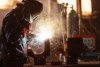
A noise assessment with Airsafe means full-shift measurement, not a spot check: we fit your workers with personal noise dosimeters and use sound level meters at each workstation. Your report shows each worker’s exposure against the standard, with controls recommended in order of the hierarchy, so you know what to fix first.
The NSW Work Health and Safety Regulation, under the Work Health and Safety Act 2011, requires employers and contractors to identify hazards, manage risks to health and safety, and then maintain and review control measures. Employers have a legal responsibility to ensure that their workers are not exposed to noise that exceeds the exposure standard.
Special provisions apply to noise, audiometric testing, and personal protective equipment (PPE). To cover these and other measures related to noise exposure, SafeWork NSW has issued a Code of Practice: Managing Noise and Preventing Hearing Loss at Work.
Health effects of noise exposure
Employees can suffer temporary or permanent hearing loss when they’re exposed to workplace noise exceeding the exposure standards. Hearing loss happens when hair cells in the inner ear are permanently damaged. Once they are destroyed, they never grow back.
Known as noise induced hearing loss (NIHL), the damage usually occurs over a number of years. Often a permanent condition, it can have a negative impact on an employee’s life.
There are also cases where loud noises like explosive powered nail guns, firearms, stamping presses and forges can damage hearing instantly. This is called acoustic trauma.
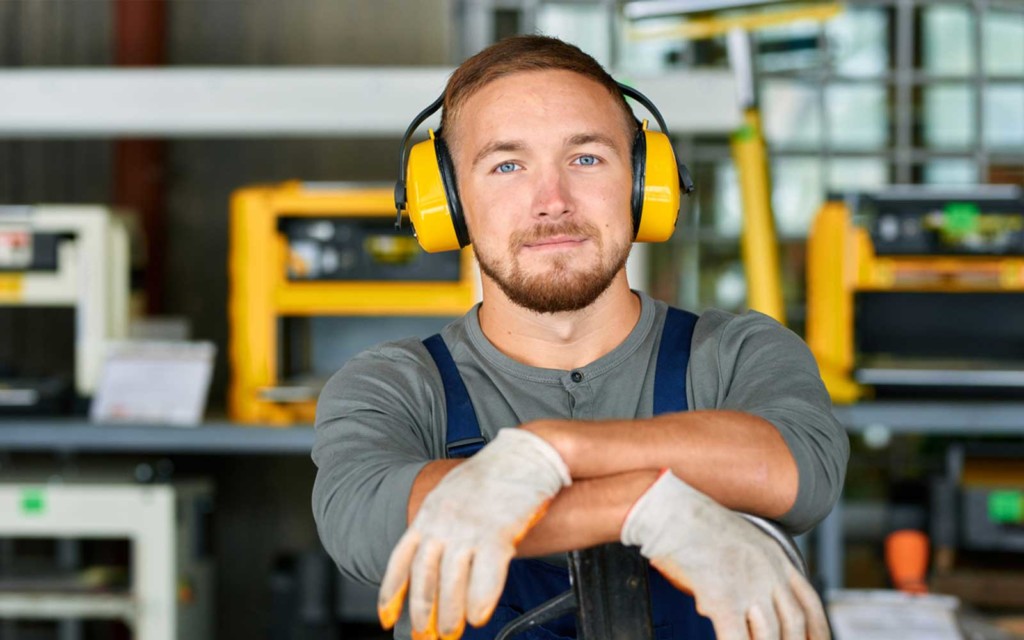
Assessing, monitoring and controlling workplace noise
Workplace exposure standards for noise
There are two different exposure standards: one representing the average noise workers can be exposed to over a working day, the other representing the maximum allowable noise they can be exposed to. The exposure standards are:
- 85 decibels measured as an average over an eight hour work day. 85 decibels is approximately the amount of noise made by a blender, lawnmower or leaf blower.
- 140 decibels as a maximum for ‘peak’ or one-off noise. Any exposure above this level can instantly damage hearing. This is approximately the amount of noise made by a sledgehammer or gunshot.
It’s worth noting that exposure levels like these represent legal maximum levels and are linked to proven hearing damage. But noise can also create an unpleasant work environment or hinder productivity even when it’s within the legal exposure standards.
When Airsafe carries out noise assessments, we recommend ways of reducing workplace noise as much as possible, even when it doesn’t exceed the exposure standards, using guidelines like the one metre rule (if a worker needs to raise their voice to talk to someone one metre away, the noise level is probably too high).
Assessing and monitoring noise levels
If you’re concerned that your workers might be exposed to excessive noise, the first step is to get noise assessment and monitoring conducted by experienced occupational hygienists like Airsafe.
To determine whether workers are potentially exposed to a noisy workplace, different parameters can be measured and compared to the current workplace exposure standards by shadowing each workstation, and by use of personal sound exposure meters.
Airsafe uses audio dosimetry consisting of a microphone and electronic recorder that is small enough to be attached to an operator. The method is good for employees who are not exposed to continuous noise because the instrument averages all noise exposure over a full shift.
Controlling noise in your workplace
As part of Airsafe’s noise assessment, we’ll recommend ways for you to control noise in your workplace. Our recommendations follow the standard hierarchy of controls, so the preference is always to eliminate the source of noise altogether if that’s possible.
If eliminating noise isn’t possible, we can recommend other options (in descending order of preference) such as:
- changing equipment to reduce noise
- putting barriers between noise sources and workers
- limiting the time a worker spends near a noise source
- using longer leads, hoses and extension cords to add distance between noisy equipment and workers
- using personal protective equipment, like earmuffs or earplugs.
SafeWork NSW provides six easy ways to keep noise levels low:
- buy quiet – look for the quietest plant and machinery for the job – ask the manufacturer/supplier for information about noise levels
- change the way you do the job – e.g. glue don’t hammer, weld don’t rivet, lower don’t drop
- reduce noise levels at the source – e.g. fit suppressors to exhausts, turn down the volume, change fan speeds
- isolate the source of the noise – e.g. use barriers, remote controls or sound-proof covers
- reduce exposure levels – e.g. restrict access to noisy areas, provide quiet areas for rest breaks, limit time spent in noisy areas
- use personal hearing protection, but only as a last resort.
If you regularly require your workers to use personal hearing protection, you must by law provide them with audiometric (hearing) testing. Under the NSW Work Health and Safety Regulation, audiometric testing must be carried out by a competent audiologist, within three months of a worker starting and at least every two years after that. Airsafe’s role is the noise assessment that tells you whether your workers are exposed above the exposure standard in the first place – and whether that obligation applies to you.
Environmental and community noise
Noise doesn’t stop at the fence line. Construction and demolition work can carry into neighbouring homes and businesses, and development consents, EPA conditions and council requirements often set limits on what’s acceptable and when. Airsafe measures environmental and community noise the same way we measure it in the workplace: with calibrated instruments, against the criteria that apply to your site, so you know where you stand and can show you’re meeting your obligations. We cover construction and demolition noise affecting neighbours, development and compliance monitoring, and noise in and around live, operating facilities.
Why choose Airsafe for noise assessments?
Airsafe is one of Australia’s most respected occupational hygiene consultancies. We measure noise with calibrated instruments to the relevant Australian Standard – so you get a clear, reliable picture of where you stand against the exposure standard.
Airsafe owns its sound level meters and noise dosimeters outright, and upgrades them regularly. So when you need a noise assessment at short notice, we’re not waiting on hire equipment – we can get straight to work.
While the hierarchy of controls itself is easy to understand, applying it to a real workplace takes expertise. That’s where our occupational hygiene team comes in: we combine the hierarchy of controls with our own experience to recommend measures that are both realistic and effective, rather than just handing you a list.
And noise rarely turns up on its own – welding brings carcinogenic fumes and radiation as well as high noise, and demolition brings dust, silica and vibration. Rather than dealing with each workplace risk in a piecemeal manner, you need a holistic, comprehensive approach – and with the same team able to assess the lot in one engagement, you’re not juggling several consultants for one site.
Case file: Sydney International Airport crew lounge upgrade
When the crew lounges at Sydney International Airport were being upgraded, Airsafe monitored environmental noise in the staffed areas around the works for about four months. The challenge was a live, round-the-clock airport: the construction had to go ahead, but flight crews needed somewhere quiet to rest between shifts. We measured noise in the occupied rest areas and adjacent workspaces during representative construction activities, compared it against the relevant criteria, and looked at the work methods and schedules driving it. From there we gave practical recommendations to manage and time the noisier work, so the upgrade could go ahead without wearing down the staff who keep the airport running.
For a noise assessment quote, get in touch with us today on 1300 888 338.
4.9 stars from over 640 Google reviews and counting, from manufacturers, builders, contractors and industrial clients across Australia.
“AIRSAFE has become our go-to company for all air monitoring needs. Working for a large paint company, we’ve found their service not only exceptional but also backed by valuable advice. They are consistently reliable, flexible, and a pleasure to work with. These qualities made it an easy decision to choose them as our preferred supplier.”– Nik Pappas, November 2025
“We recently appointed Airsafe to undertake air monitoring and reporting at a brownfield development site during the demolition stage. Their proactive, professional and cost and time-efficient approach and implementation were excellent.”– Carl O. Peterson, December 2021
“I use Airsafe on a regular basis for commercial construction. Liam Matthews and the Airsafe team always get the job done professionally, safely, and in a prompt manner as required. If only I could give more stars.”– Jordan Kissane, September 2021
FAQs
-
There are two limits. The first is an average: 85 decibels (dB(A)) measured over an eight-hour working day – about the noise of a blender, lawnmower or leaf blower. The second is a peak: 140 decibels (dB(C)) for one-off noise, above which hearing can be damaged instantly, like a sledgehammer blow or a gunshot. If your workers are exposed above either limit, you have a legal duty to control it. It’s also worth reducing noise even below these limits, because noise can make a workplace unpleasant and harder to work in well before it reaches the legal maximum.
-
We measure the noise your workers are actually exposed to and compare it against the exposure standard. That can mean shadowing individual workstations with a sound level meter, or fitting a worker with a personal noise dosimeter – a small microphone and recorder that averages their noise exposure across a full shift, which is useful for workers who move around or aren’t exposed to constant noise. We measure with calibrated instruments to the relevant Australian Standard, then report clearly on where you stand and what, if anything, needs to change.
-
If you regularly require workers to wear hearing protection because their noise exposure exceeds the standard, then yes – under the NSW Work Health and Safety Regulation you must provide audiometric testing, within three months of a worker starting and at least every two years after that. Audiometric testing is a hearing test carried out by a competent audiologist. Airsafe doesn’t perform audiometric testing itself, but our noise assessment is what tells you whether your workers are over the exposure standard, and therefore whether the testing obligation applies to you. Just call us on 1300 888 338 if you’d like to work out where you stand.
-
We follow the standard hierarchy of controls, starting with the most effective: eliminating the noise source altogether if possible, then quieter equipment, barriers between the source and workers, more distance, limiting time spent near the noise, and – only as a last resort – hearing protection like earmuffs or earplugs. As part of any noise assessment we give you practical, realistic options ranked by how well they’ll actually work, not just a list. The aim is to get you compliant with the least disruption to how you run the place.
-
Yes. Noise rarely turns up on its own – it’s usually one of several hazards on a site. Welding brings fumes and radiation as well as noise; demolition and construction bring dust, silica and vibration. With our holistic approach to occupational hygiene, the same team can assess all of them in one go, so you’re not coordinating several different consultants for one workplace. Just call us on 1300 888 338 to talk through what your site needs.
Contact us for a noise assessment today
Some amount of noise is an unavoidable part of doing business, but excess noise levels don’t just make a workplace unpleasant and stressful – they can cause permanent hearing damage to you and your workers. And if you’re not controlling noise properly, you may be breaking the law.
Airsafe can help you make sure you comply with your legal obligations, and keep your employees protected from excess noise. We work across Sydney, NSW and Australia, with travel built into our quotes for sites further afield.
Contact us for a fast quote on a noise and safety assessment, or call Airsafe on 1300 888 338.
Last updated: August 2026