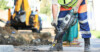
Vibration matters in two quite different ways. On a construction site, it travels out into neighbouring buildings, where it can disturb the people inside, upset sensitive equipment, or – at higher levels – cause cosmetic damage. In a workplace, it travels into the workers themselves, through the tools they hold and the plant they operate, where over time it can cause lasting injury. Airsafe assesses both.
Construction and structural vibration
The effects of vibration on buildings can be divided into the following main assessment categories:
- those in which the occupants or users of the building are inconvenienced or possibly disturbed (‘tactile vibration’)
- those where a building’s contents may be affected (for example, the operation of vibration-sensitive equipment such as microscopes in hospitals)
- vibration affecting buildings and structures in terms of their susceptibility to damage (‘structural damage’).
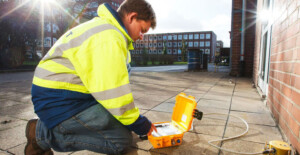
Human comfort vibration
The NSW EPA’s Assessing Vibration: a technical guideline (2006) provides guideline values for continuous, transient and intermittent events that are based on a Vibration Dose Value (VDV) rather than a continuous vibration level. The VDV depends on the level and duration of the vibration event, as well as the number of events occurring during the daytime or night-time period.
Structural damage vibration
Structural damage vibration limits are based on Australian Standard AS 2187.2-2006 Explosives – Storage and Use, Part 2: Use of Explosives, and British Standard BS 7385 Part 2-1993 Evaluation and measurement for vibration in buildings, Part 2. These standards provide frequency-dependent vibration limits related to cosmetic damage, noting that cosmetic damage is very minor in nature, is readily repairable, and does not affect the structural integrity of the building.
Where the dynamic loading caused by continuous vibration may give rise to dynamic magnification due to resonance – especially at the lower frequencies, where lower guide values apply – the guide values may need to be reduced by up to 50%.
Rock breaking and hammering activities are considered to have the potential to cause dynamic loading in some structures (for example, residences), so it is appropriate to reduce the transient values by 50%.
At locations where the predicted or measured vibration levels are greater than the relevant peak component particle velocity, a more detailed analysis of the building structure, vibration source, dominant frequencies and dynamic characteristics of the structure should be undertaken to determine the applicable safe vibration level.
Occupational vibration: are your workers at risk?
Vibration doesn’t only travel outward into buildings – it travels into the people using the equipment. Workers who operate vibrating tools or plant day after day can suffer serious, often permanent injury, and it comes on gradually enough to be easy to miss until the damage is done. There are two kinds.
Hand-arm vibration (HAV) comes from hand-held or hand-guided powered tools – angle grinders, jackhammers, rock breakers, impact wrenches and chainsaws among them. Over time it can cause hand-arm vibration syndrome (HAVS), including the condition often called vibration white finger. A number of symptoms can come from exposure to hand-arm vibration, including:
- tingling and numbness in the fingers
- loss of grip strength
- blanching (whitening) of the fingers, especially in the cold.
Construction, demolition, mining, foundry work and manufacturing are among the most affected industries.
Whole-body vibration (WBV) comes from operating vibrating plant and vehicles – excavators, haul trucks, compactors and forklifts – where the vibration passes into the body through the seat or the floor. It’s associated with back pain and longer-term spinal and musculoskeletal problems.
If you’re in charge of a workplace where people regularly use vibrating tools or plant, you have a legal responsibility to manage the risk. Unlike noise, vibration has no single legislated exposure standard in Australia. Instead, it falls under your general duty under the Work Health and Safety Act: to eliminate workers’ exposure so far as is reasonably practicable, and where you can’t, to minimise it. For hand-arm vibration, the hazardous manual tasks provisions of the Work Health and Safety Regulation apply as well.
Identifying, evaluating and controlling vibration exposure is a complex process, and difficult to do without expert help. Airsafe’s occupational hygiene team assesses hand-arm vibration to AS ISO 5349.1 and 5349.2, and whole-body vibration to AS 2670.1. We measure each worker’s daily exposure – an eight-hour average known as A(8) – and compare it against the action and limit values widely used as a benchmark in Australia, drawn from the European Union’s vibration directive, so you get a clear picture of the risk. From there, our recommendations follow the standard hierarchy of controls, so the preference is always to reduce the vibration at its source if we can – lower-vibration tools and well-maintained plant – before falling back on measures like limiting exposure time, rotating tasks, and suspension seating for plant operators.
Why choose Airsafe for vibration monitoring?
Airsafe can undertake vibration monitoring – on site or for worker exposure – following all the relevant legislative, standard and guideline requirements.
We’re proud of our methodical, systematic and diligent procedures for carrying out vibration monitoring. To undertake monitoring or a clearance, an Airsafe staff member must:
- be completely familiar with the relevant documents
- be competent in the use of all vibration monitoring equipment
- be signed off by a supervisor
- undergo routine reviews of all testing skills and technique.
If your occupational hygienist isn’t backed by rigorous procedures like Airsafe’s, there’s a risk that your results won’t be compliant. The vibration monitoring equipment itself is ours – Airsafe’s own instruments, calibrated and maintained by us – so monitoring can start when your project needs it. And because noise and vibration so often go together – on a construction site and at a workbench alike – the same Airsafe team can handle both in one engagement. See our noise assessments and monitoring page.
Contact us today for a fast quote on vibration monitoring.
“We recently appointed Airsafe to undertake air monitoring and reporting at a brownfield development site during the demolition stage. Their proactive, professional and cost and time-efficient approach and implementation were excellent.”
– Carl O. Peterson, December 2021
“AIRSAFE has become our go-to company for all air monitoring needs. Working for a large paint company, we’ve found their service not only exceptional but also backed by valuable advice. They are consistently reliable, flexible, and a pleasure to work with. These qualities made it an easy decision to choose them as our preferred supplier.”
– Nik Pappas, November 2025
“I use Airsafe on a regular basis for commercial construction. Liam Matthews and the Airsafe team always get the job done professionally, safely, and in a prompt manner as required. If only I could give more stars.”
– Jordan Kissane, September 2021
Frequently asked questions
-
Usually when your work could shake a neighbouring building or disturb the people in it – think demolition, rock breaking, piling, blasting, heavy plant, or excavation close to other structures. Vibration monitoring is often a condition of a development consent or a construction environmental management plan, so that you can show the work stayed within the limits and didn’t damage neighbouring buildings or unreasonably disturb occupants. If you’re not sure whether your project needs it, call us on 1300 888 338 and we’ll tell you straight.
-
Two things get assessed. For people, the NSW EPA’s Assessing Vibration: a technical guideline (2006) sets human-comfort values based on a Vibration Dose Value, which accounts for how strong the vibration is, how long it lasts, and how often it happens, day or night. For buildings, structural-damage limits come from AS 2187.2-2006 and BS 7385 Part 2-1993, which set frequency-dependent limits for cosmetic damage. Some activities, like rock breaking and hammering, warrant reducing the transient limits by half because of the way they load a structure.
-
They’re the two ways vibration harms workers. Hand-arm vibration (HAV) comes up through hand-held powered tools like grinders, jackhammers and chainsaws, and over time can cause hand-arm vibration syndrome – including vibration white finger, with numbness, tingling and loss of grip. Whole-body vibration (WBV) comes up through the seat or floor when operating plant and vehicles like excavators, compactors and forklifts, and is linked to back and spinal problems. Airsafe assesses both – HAV to AS ISO 5349, WBV to AS 2670.1
-
Not a single legislated exposure standard like the one for noise – Australia doesn’t have one for vibration. Instead, you have a general duty under the Work Health and Safety Act to eliminate workers’ exposure to vibration risk so far as is reasonably practicable, and to minimise it where you can’t, and for hand-arm vibration the hazardous-manual-tasks provisions of the Regulation also apply. In practice, occupational hygienists measure daily exposure and compare it against widely used benchmark values (drawn from the European vibration directive) to judge the risk. Airsafe can do that assessment and tell you where your workers actually stand.
-
For construction vibration, we place calibrated equipment at the locations that matter – usually the nearest or most sensitive neighbouring structures – and measure against the relevant human-comfort and structural-damage limits. For worker exposure, we measure the vibration coming through the tools or plant and work out each worker’s daily A(8) exposure. Either way, our procedures are deliberately methodical: our people have to be familiar with the relevant documents, competent on the equipment, signed off by a supervisor, and routinely reviewed, because if the monitoring isn’t done rigorously, your results may not stand up.
-
Yes, and it usually makes sense to. Noise and vibration come from the same activities – whether that’s a demolition site or a worker on a grinder all day – and on construction projects they’re often both conditions of your consent. Having one experienced team handle both saves you coordinating two. See our noise assessments and monitoring page, or just call us on 1300 888 338 to talk through what you need.
Contact us for vibration monitoring today
Whether your concern is vibration travelling out to neighbouring buildings or up into your workers, the answer starts the same way: measuring it properly, against the right standards, so you know where you stand instead of guessing.
We work across Sydney, NSW and Australia, with travel built into our quotes for sites further afield.
Contact us for a fast quote on vibration monitoring, or call Airsafe on 1300 888 338.