At sites where asbestos was used as a building material, it’s common to find it has contaminated the surrounding soil. Former waste disposal, demolition, buried building rubble and imported fill are among the usual causes. Contamination is most often picked up during a change of land use, industrial to residential, say, and it can have serious consequences for councils, landowners, buyers and developers. Asbestos in soil rarely stops a project, but it does have to be found, assessed and managed properly before the project can move.
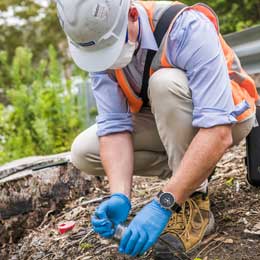
The three forms of asbestos in soil
Asbestos in soil is a physical contaminant, it turns up as fragments and fibres of different shapes, sizes and condition, not as a dissolved chemical. It’s grouped into three forms:
- Bonded Asbestos-Containing Material (ACM), non-friable material such as fibro sheeting, where the fibres are bound in cement or another matrix.
- Fibrous Asbestos (FA), friable material such as loose insulation or pipe lagging, or any material that can be crumbled or broken by hand pressure. Bonded material like fibro can also become friable once it has been weathered, broken or damaged.
- Asbestos Fines (AF), free fibres and small fragments (under about 7mm) that have come from degraded, broken, damaged or weathered ACM or FA.
The reason the form matters is that friable and fine asbestos releases fibres far more readily when the soil is dry and disturbed, which is exactly what happens during excavation and earthworks.
Why asbestos in soil is different
Soil is harder to assess than the materials above it, you can’t simply look at a surface, because the asbestos has to be dug up to be found. That’s why, on a building clearance, we’ll usually note that asbestos may still be present in the soil beneath a site: we can’t get to it to test it unless there’s a specific reason to. A proper asbestos-in-soil investigation goes looking for it deliberately, with a sampling plan designed for the site.
The form also varies. It may be an inherently friable type like pipe lagging, or a bonded type like fibro that has become friable after years in the ground. Both change how the site has to be assessed, managed and cleared.
How we assess asbestos in soil
An asbestos-in-soil assessment is a specialised case of a contaminated land assessment, and we run it the same disciplined way (see our Contaminated Land Assessments page for the full four-stage process). In short:
- We review the site history and inspect the site to work out where asbestos is likely to be and why.
- We recover samples to a sampling and analysis plan built for the site, following the methodology in the Western Australian Department of Health guidelines, which are the accepted Australian standard for asbestos in soil.
- We identify the asbestos in our own NATA-accredited laboratory and assess the results against the criteria in the National Environment Protection (Assessment of Site Contamination) Measure. Those criteria depend on how the land will be used, residential land is assessed most conservatively, commercial and industrial less so.
- We report what’s there, how much, and where, and set out the management or remediation approach needed to make the site suitable for its intended use. Where management plans are needed to meet legislative, regulatory or project requirements, we prepare those too.
Tested in our own NATA-accredited laboratory
This is where asbestos in soil differs from the rest of contaminated land. For the general chemistry of a contaminated site, metals, hydrocarbons, PFAS and the like, samples go to an external NATA-accredited laboratory. Asbestos is different: we identify it ourselves, in Airsafe’s own NATA-accredited laboratory in Sydney, by polarised light microscopy and dispersion staining in accordance with AS 4964.
Having the asbestos work in-house means two things. You get a fast, definitive answer instead of waiting on a third-party lab. And because we own the lab and don’t do the removal, there’s no commercial pressure to under-sample or over-call a result, the answer is just the answer. Many consultants don’t own a lab and send every sample out; we don’t have to.
We assess. A licensed contractor removes.
Airsafe is an independent consultant. We find the asbestos, work out the extent, write the management or remediation approach, and validate the site once the work is done. We don’t carry out the removal, a separate licensed asbestos removalist does that, and we can put the work out to tender and oversee it for you.
Asbestos-contaminated soil also has to be disposed of correctly. It’s classified as Special Waste (Asbestos Waste) under the NSW EPA waste classification framework, it can’t be reused on site as clean fill, and it can’t be classified as VENM or ENM. We sort out the classification so the soil goes where it’s legally allowed to go. There’s more on soil classification on our Waste & VENM Assessment page.
Because we don’t sell the remediation, there’s no conflict of interest in our reports, which is exactly why councils, buyers and regulators rely on them. Where the work supports a development application, our reports are signed off by Michael Edwards, our Certified Environmental Practitioner (Site Contamination Specialist), recognised by the NSW EPA.
Just one suspect sample?
If you’ve got a single sample of soil you think contains asbestos, rather than a whole site to assess, you can send it straight to our laboratory for testing. Take the sample safely:
- Wear a P2 disposable dust mask when handling suspect material. You can buy one at any hardware store.
- Wet the soil down first to keep the dust down.
- Carefully collect about 100g using hand tools. A larger sample is no help and takes longer to test.
- Seal it in a click-lock plastic bag, then bag it a second time.
- Stay away from the area until testing is complete.
Then bring the double-bagged sample in to Airsafe at Level 1, 488 Botany Road, Beaconsfield NSW 2015, call us first on 1300 888 338 to let us know you’re coming, or call us to arrange another way to get it to us. If the sample turns out to contain asbestos, you’ll want expert help from an asbestos consultant, and we can take it from there. If you need a VENM report to move clean soil off site, we can do that too.
4.9 stars from over 640 Google reviews, from builders, demolition and remediation contractors, developers, councils and government across NSW.
“We recently appointed Airsafe to undertake air monitoring and reporting at a brownfield development site during the demolition stage. Their proactive, professional and cost and time-efficient approach and implementation were excellent.”
Carl O. Peterson, December 2021
“AIRSAFE (Sydney) has been a reliable service provider for our asbestos business for many years now, providing professional laboratory testing and hygienist clearances to support our Asbestos operations. The staff are reliably friendly and super-efficient. We highly recommend their services based on our experience.”
Anita French, June 2024
“AIRSAFE has become our go-to company for all air monitoring needs. Working for a large paint company, we’ve found their service not only exceptional but also backed by valuable advice. They are consistently reliable, flexible, and a pleasure to work with. These qualities made it an easy decision to choose them as our preferred supplier.”
Nik Pappas, November 2025
Frequently asked questions
-
Usually when ground is going to be disturbed or a site is changing hands or changing use, a development application, a subdivision, demolition, earthworks, or a sale. If a site has a history that suggests asbestos could be in the ground (old buildings, demolition, imported fill, former industrial use), a council or regulator will generally want it assessed before they’ll approve the work. If you’re not sure, call us on 1300 888 338 and we’ll tell you whether you need one.
-
Not reliably. Larger fragments of bonded fibro or fibrous asbestos can sometimes be spotted, but asbestos fines and free fibres can’t be seen, and material gets disguised once it’s mixed through soil and fill. The only way to be sure is to recover samples properly and have them identified in a laboratory. That’s what an asbestos-in-soil investigation is for.
-
Yes, for asbestos. Asbestos identification is done in Airsafe’s own NATA-accredited laboratory in Sydney, by polarised light microscopy and dispersion staining in accordance with AS 4964. That means a fast, definitive answer with full legal weight. For the wider chemistry of a contaminated site, metals, hydrocarbons and so on, samples go to an external NATA-accredited laboratory, which we arrange as part of a full site assessment.
-
Asbestos-contaminated soil is classified as Special Waste (Asbestos Waste) under the NSW EPA waste classification framework. It can’t be reused on site as clean fill, and it can’t be classified as VENM or ENM. Depending on the assessment, some of it may be able to be remediated, but soil that has to leave the site has to go to a facility licensed to accept asbestos waste. We sort out the classification so it goes where it’s legally allowed to go.
-
No. Airsafe is an independent consultant. We find the asbestos, assess the extent, write the management or remediation approach and validate the site once the work is done. The removal itself is carried out by a separate licensed asbestos removalist. We can put the work out to tender and oversee it for you.
Need help with asbestos in soil?
Whether you’re a developer, builder, council or landowner with a whole site to assess, or you just need one suspect sample tested, Airsafe can help, with our own NATA-accredited asbestos laboratory behind every result.
To organise an asbestos-in-soil assessment, call us on 1300 888 338.
Last updated: June 2026