What are welding fumes?
Welding fumes are a complex mixture of hazardous chemicals produced during welding.
Welding fumes contain a complicated and potentially hazardous combination of metals, metal oxides, silicates, and fluorides. When a metal is heated over its boiling point, its vapours condense into very small particles, resulting in the formation of fumes (solid particulates). Welding fumes often comprise particles from the electrode as well as the substance being welded.
The exact composition of welding fumes depends on a number of factors, including:
- the welding process
- the metal(s) being welded
- shielding gases or flux used
- the composition of the welding rod
- any contaminants or coatings present on the metal being welded.
What are the health effects of welding fumes?
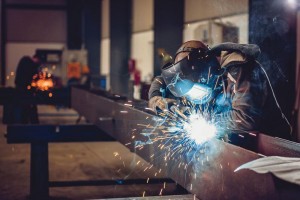
Welding is an activity of vast importance to our construction and manufacturing industries. It’s also one of the riskiest activities people undertake at work, and some of the most insidious risks come from long-term exposure to fumes.
In 2017, the International Agency for Research on Cancer (IARC) reclassified welding fumes as a Group 1 carcinogen, meaning there is sufficient evidence to show they are carcinogenic to humans. Previously, they had been classified as Group 2B, meaning “possibly carcinogenic to humans”. The reclassification came from a review of studies showing that welders had an abnormally high rate of lung cancer, which could not be attributed to other hazards like smoking or asbestos exposure. At the same time, the IARC classified the UV radiation generated by electric arc welding as a Group 1 carcinogen, as it has been shown to cause ocular melanoma.
Acute exposure to welding fumes and gases can result in eye, nose and throat irritation, dizziness and nausea. Prolonged exposure to welding fumes may cause lung damage and various types of cancer, including cancer of the lungs, larynx or urinary tract.
Health effects from certain individual substances in fumes may include metal fume fever, stomach ulcers, kidney damage and nervous system damage. Prolonged exposure to manganese fume can cause Parkinson’s-like symptoms.
Exposure standards and your responsibilities
If you’re a person conducting a business or undertaking (PCBU), you have a responsibility to ensure that no person in your workplace is exposed to an airborne contaminant in a concentration that exceeds the relevant exposure standard.
Welding fumes can contain a number of different chemicals, each of which has its own exposure standard listed in the workplace exposure standards for airborne contaminants (becoming workplace exposure limits from December 2026). On 18 January 2024, the overall standard for welding fumes (not otherwise classified) was reduced from 5 mg/m3 to 1 mg/m3 as an eight-hour time weighted average – that is, the maximum average airborne concentration of welding fumes calculated over an eight-hour working day, for a five-day working week. That figure carries through under the new exposure limits.
The individual chemicals within the fume are a different story. From December 2026, the limits for several of them are tightening – the limit for manganese fume, for example, drops to a tenth of its previous level. Because the makeup of welding fume depends on the metal, the process and the consumables, the only way to know whether you’re meeting all the relevant limits is to identify what your fume actually contains, and measure it.
How do you measure welding fumes?
A monitoring program, including air monitoring, is required under work health and safety regulations when:
- an employer cannot be certain, on reasonable grounds, that the airborne concentration of a hazardous substance is below the exposure standard, or
- monitoring is necessary to determine the risk to worker health.
Keeping workers below the exposure standard is the minimum legislative requirement, but good occupational hygiene practice aims to reduce exposure to a level as low as reasonably practicable.
Because welding fume is breathed in at the work face, personal exposure monitoring is the primary method: the sampling device is worn in the worker’s breathing zone over a representative period, sampled to the Australian Standard AS 3640-2009 Workplace atmospheres – Method for sampling and gravimetric determination of inhalable dust. We can also use static monitoring in a fixed position to check how well controls such as local exhaust ventilation are working.
Managing welding fume risk in your workplace
-
To determine the risk of exposure to fumes during welding, Airsafe will help you to identify what equipment and materials are being used and the level of fumes, dust, vapour and gases they are generating.
To give one example, phosphine is generated when steel which is coated with a rust- proofing compound is welded. High concentrations of phosphine gas are irritating to the eyes, nose and skin. The substance can have detrimental effects on the lungs and other organs. If this was the situation in your workplace, In order to prevent exposure to phosphine, you would first identify rust-proofed steel in the material to be welded.
-
If Airsafe’s monitoring team finds that concentrations of welding fumes are too high in your workplace, especially if they exceed workplace exposure standards, we will advise you on the best course of action to control people’s exposure to fumes.
Our advice follows the standard hierarchy of controls:
- Elimination of exposure to welding fumes, if possible, is always the preferred solution.
- If elimination is not possible, we look at substitution of hazardous chemicals with less hazardous ones.
- We then consider engineering controls such as isolation or ventilation systems.
- Next, we advise you on any administrative controls you may need to implement – for example, changes in your procedures around handling chemicals.
- Finally, we’ll advise you on what personal protective equipment is necessary to minimise your workers’ exposure to hazardous fumes.
-
Welding is a high-risk activity that potentially carries a number of hazards in addition to those associated with fumes. These include:
- radiation which can cause eye disorders and skin burns if not properly controlled; the UV radiation generated by electric arc welding is classified as a Group 1 carcinogen
- electrical risks associated with operating welding equipment, especially if it is not correctly maintained, or with electromagnetic fields generated by electric arc welding
- fire and explosion when heat, flames and sparks generated by welding come into contact with a fuel source
- burns and heat exposure from working with equipment that can reach as high as 6000 degrees Celsius
- compressed and liquefied gases used in certain types of welding that can cause asphyxiation among other hazards
- high noise levels, especially generated by plasma arc welding
- lead exposure when welding on steel painted with leaded paints or older materials contaminated with lead
- ergonomic hazards such as working in confined spaces, falls, and back strain.
SafeWork NSW has a code of practice for welding activities, and has summarised the main points in this video:
Why choose Airsafe for welding fume monitoring?
Airsafe gives you the reassurance of dealing with one of Australia’s most experienced and respected occupational hygiene consultancies. We’ve been identifying, measuring and controlling workplace hazards since 1988.
For welding fume air monitoring, Airsafe is accredited by NATA for volume measurement. We sample fume in the worker’s breathing zone using NATA-accredited equipment, then send the filters to a dedicated NATA-accredited analysis laboratory. All Airsafe test reports have metrological traceability, and all work is completed in accordance with the relevant Australian Standard.
Welding rarely brings just one hazard. With our holistic approach to occupational hygiene, the same team can identify, evaluate and control the other risks that come with welding – heat, noise, UV radiation, lead, confined spaces and more – so you’re not juggling several consultants for one work process.
Case file: Charles Darwin University welding fume assessment
Charles Darwin University asked Airsafe to find out what its welding instructors and students were actually breathing during workshop classes. We ran personal exposure monitoring on representative welding tasks for both staff and students, looked at the airborne contaminants the different processes give off, and reviewed the ventilation and controls already in place, comparing the results against the relevant exposure standards. Because students did most of the welding, it was also a good chance to show people coming into the trade, early on, why welding fume matters and what proper control looks like. We handed back a clear picture of exposure levels along with practical recommendations to improve ventilation and make the workshops safer to learn and work in.
For a welding fume monitoring quote, get in touch with us today on 1300 888 338.
4.9 stars from over 640 Google reviews and counting, from fabricators, manufacturers, builders and industrial clients across Australia.
AIRSAFE has become our go-to company for all air monitoring needs. Working for a large paint company, we’ve found their service not only exceptional but also backed by valuable advice. They are consistently reliable, flexible, and a pleasure to work with. These qualities made it an easy decision to choose them as our preferred supplier.
Nik Pappas, November 2025
We recently appointed Airsafe to undertake air monitoring and reporting at a brownfield development site during the demolition stage. Their proactive, professional and cost and time-efficient approach and implementation were excellent.
Carl O. Peterson, December 2021
I use Airsafe on a regular basis for commercial construction. Liam Matthews and the Airsafe team always get the job done professionally, safely, and in a prompt manner as required. If only I could give more stars.
Jordan Kissane, September 2021
Frequently asked questions
-
Welding fumes are a complex mixture of hazardous chemicals – metals, metal oxides, silicates and fluorides – formed when metal is heated above its boiling point and the vapour condenses into very fine particles. The exact makeup depends on the metal being welded, the process, the consumables and any coatings on the metal. The International Agency for Research on Cancer classifies welding fumes as a Group 1 carcinogen, meaning there is sufficient evidence that they cause cancer in humans. Short-term exposure can cause eye, nose and throat irritation, dizziness and nausea; long-term exposure can cause lung damage and cancer of the lungs, larynx or urinary tract.
-
On 18 January 2024, the overall standard for welding fumes (not otherwise classified) was reduced from 5 mg/m3 to 1 mg/m3, as an eight-hour time weighted average. That means a worker’s average exposure across an eight-hour working day must not exceed 1 mg/m3, and that figure carries through under the new Workplace Exposure Limits that apply from December 2026. On top of the overall limit, individual chemicals within the fume – like manganese, nickel and hexavalent chromium – each have their own limit, and several of these are tightening from December 2026. Meeting all of them is why expert monitoring matters.
-
Under work health and safety regulations, you need to arrange air monitoring when you can’t be confident, on reasonable grounds, that exposure is below the standard, or when monitoring is needed to work out the risk to your workers’ health. In practice, that covers most regular welding work, especially in enclosed or poorly ventilated spaces. Personal monitoring measures what the welder actually breathes in, sampled in the breathing zone over a representative period. If you’re not sure whether your work needs monitoring, just call us on 1300 888 338 and we’ll talk it through.
-
We take welding fume samples on site using equipment accredited by NATA for volume measurement, then send the filters to a dedicated NATA-accredited analysis laboratory. All work is completed in accordance with the relevant Australian Standard, and all our test reports have metrological traceability.
-
Yes. Welding rarely brings just one hazard, and our holistic approach to occupational hygiene means the same team can look at the lot. Alongside fume monitoring, we can identify, evaluate and control heat stress, noise, UV radiation, lead exposure from painted or contaminated metal, confined-space risks and more. That means you’re not coordinating several different consultants for one work process. Just call us on 1300 888 338 to talk through what your site needs.
Contact us for a welding fume risk assessment today
Airsafe’s trained and qualified occupational hygienists can be dispatched today to conduct exposure monitoring and provide recommendations on health monitoring. With our holistic approach to occupational hygiene, we can also help you identify, evaluate and control the other hazards that come with welding, such as excessive heat and noise. We work across Sydney, NSW and Australia, with travel built into our quotes for sites further afield.
For any questions about welding fumes, call Airsafe on 1300 888 338.
Last updated: July 2026