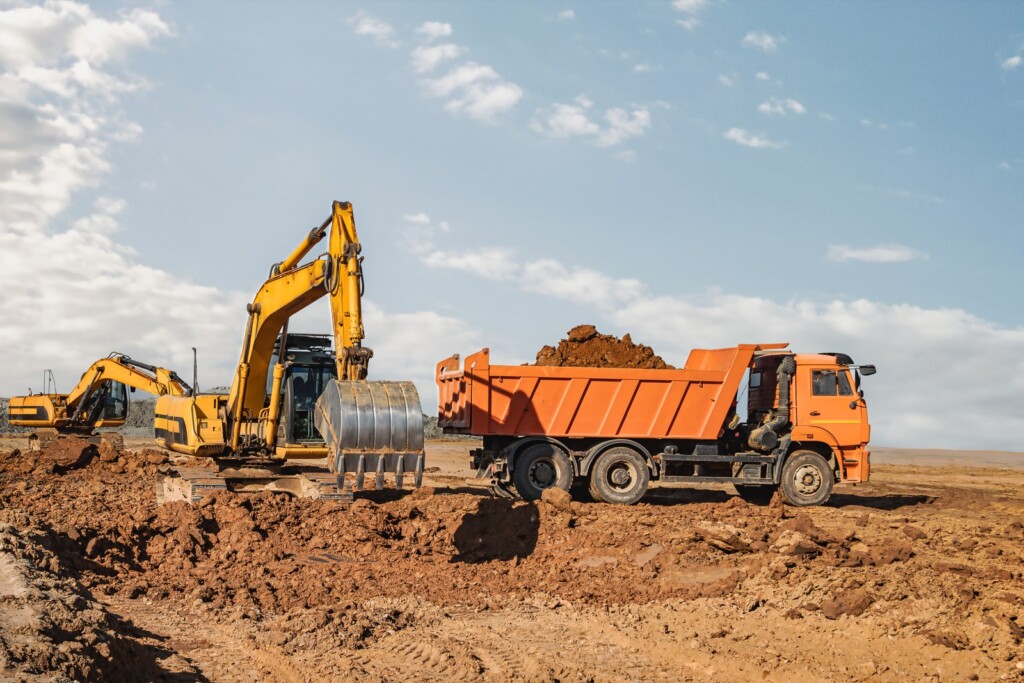
If you’re excavating soil and want to reuse it at another site rather than pay to landfill it, the first question is what the material actually is. In NSW, clean and near-clean soil can be classified as VENM or ENM. The difference between the two comes down to the history of the land it came from, and how much testing is needed before the soil can leave your site.
Both classifications exist so good soil isn’t wasted. Landfill levies on soil are substantial, and a classification that lets the material be reused instead can save serious money on an excavation job.
What is VENM?
Virgin Excavated Natural Material (VENM) is defined in the Protection of the Environment Operations Act. It’s natural material such as clay, gravel, sand, soil or rock fines, excavated or quarried from land that isn’t contaminated with manufactured chemicals or process residues from industrial, commercial, mining or agricultural activity, and that doesn’t contain sulfidic ores or soils or any other waste.
In other words, VENM is soil from land that has stayed clean: the simplest case. The advantage of having soil classified as VENM is that you can sell it to be reused at another site, what used to be called “clean fill”.
Classifying soil as VENM is mostly about the history of the land. The assessment looks at past and present activities on the site and the surrounding area, and asks whether anything could have contaminated the material: a former service station up the road, fill of unknown origin, agricultural chemicals, industrial fallout. Acid sulfate soil risk maps and naturally occurring asbestos maps are checked too. Chemical testing isn’t always required for VENM, but where the history can’t rule contamination out, testing may be the only way to establish it.
What is ENM?
Excavated Natural Material (ENM) covers naturally occurring rock and soil that doesn’t meet the VENM definition, usually because the land has been disturbed or the material carries low-level contamination. To qualify, the material must be at least 98% natural material by weight, and it has to be sampled and tested against the chemical criteria in the EPA’s Excavated Natural Material Order 2014. Material that passes can be reused off site as engineering fill or in earthworks.
The Order sets out exactly how much testing is needed. A stockpile under 500 tonnes needs at least three samples analysed; larger stockpiles need more, and above 4,000 tonnes the sampling program repeats. Material still in the ground is sampled on a grid based on the area, with extra samples at depth. Every sample is tested for a fixed list of contaminants, including heavy metals, hydrocarbons and foreign material, against maximum concentrations set in the Order. The testing has to be done by a NATA accredited laboratory.
There’s paperwork as well. Whoever supplies ENM must give each receiver a written statement of compliance, and keep records of the sampling plan, the results, the quantities and where the material went, for six years.
What can’t be VENM or ENM
Neither classification can contain asbestos, acid sulfate soils, potential acid sulfate soils, or sulfidic ores. If any asbestos is found in the material, bonded or friable, it has to be classified as Special Waste (Asbestos Waste). Material that has been processed, or that comes from a contamination hotspot, can’t be ENM either.
Why getting it right matters
The classification decides what’s legal and what it costs. Classify too low and you risk illegal disposal and serious penalties: under the Protection of the Environment Operations Act, supplying false or misleading information about waste is an offence in its own right. Classify too high and you pay landfill rates for material another site would have paid you for. On a job moving thousands of tonnes of soil, that adds up quickly.
Who does the classification?
Legally, classifying waste is the responsibility of the person who generates it. A VENM certificate can be completed by the generator, or by a consultant acting on their behalf; it isn’t required by law, but receiving sites generally want one before they’ll accept the soil. In practice, most builders and developers have an environmental consultant do the assessment, because the consultant can dig into the site history, design the sampling program, and produce documentation that landfills, receiving sites and councils will accept.
How Airsafe can help
Since 1988, Airsafe has classified soil and waste for builders, developers, demolition and remediation contractors, councils and government across Sydney and NSW. We review the site’s history, design a sampling program for the material, have the chemistry analysed at an external NATA accredited laboratory, and identify any asbestos in our own NATA accredited laboratory. Where PFAS is a possibility, we assess for it in line with the Waste Classification Guidelines. You get a VENM or ENM assessment, or a waste classification report, that complies with EPA and council requirements.
To find out whether your soil can be reused, learn more on our Waste & VENM Assessment page, or call Airsafe on 1300 888 338.
Questions people ask
How do I get a VENM certificate?
A VENM certificate is usually based on a review of your site history and nearby land uses, with checks for things like acid sulfate soil risk and naturally occurring asbestos. The generator can complete it, or a consultant can do it for you. Receiving sites commonly ask for one before taking the soil.
Can soil with asbestos in it ever be VENM or ENM?
No. VENM and ENM cannot contain asbestos. That applies whether the asbestos is bonded or friable. If asbestos is found in the material, it has to be classified as Special Waste (Asbestos Waste), so it cannot be treated as clean fill, VENM or ENM for reuse.
How many soil samples are needed for a VENM or ENM assessment?
For ENM, the number depends on the amount of material and whether it is stockpiled or still in the ground. A stockpile under 500 tonnes needs at least three samples, with more for larger stockpiles. For VENM, chemical testing is not always needed, unless the site history cannot rule out contamination.