What should you do first?
If asbestos, or something that looks like asbestos, has turned up in soil on your site, stop disturbing that part of the site.
Don’t keep digging through it to see how much is there. Don’t dry-sweep it, rake it or stockpile it with other material. If it is safe to do so, isolate the area, keep the soil damp, and cover the suspect material with plastic sheeting. Then get it assessed.
Asbestos-contaminated soil presents complex problems that can be expensive to solve. That’s why, when you find asbestos in soil, it’s especially important to get expert help.
The risk comes from asbestos fibres becoming airborne and being breathed in. Dry, disturbed soil is the situation to avoid, particularly if friable asbestos or asbestos fines are present.
How does asbestos get into soil?
In most cases, asbestos in soil is a legacy issue.
It may be asbestos waste that has formerly been illegally dumped at the site, or just left behind and buried at a time when the need for safe disposal wasn’t so well known. It can also come from old demolition or renovation debris, buried fibro fragments, or fill that was brought onto the site years ago.
Waste is a natural byproduct of construction: you demolish a building, you dig a hole in the ground to lay foundations, and you end up with materials that you need to do something with. If asbestos-containing material was mixed into that material, buried, or used as fill, it can remain in the ground until later excavation exposes it.
That is why asbestos in soil is often discovered during demolition, landscaping, service trenching, footing excavation or site preparation.
Why is soil harder than asbestos in a building?
Soil is more difficult to “inspect” than above-ground materials. It has to be dug up.
In a building, an assessor can often inspect a sheet, a ceiling lining, a pipe lagging or a vinyl tile and then take a sample. In soil, larger bonded fragments may be visible, but small fragments and asbestos fines can be mixed through the soil. You cannot reliably identify asbestos in soil by sight.
Laboratory testing is simply the only way to tell if something is or isn’t asbestos.
The extent of contamination can be difficult to pin down, and excavating soil from a large site is a massive operation. Disturbing the soil is also part of the investigation problem, because disturbance can release fibres if friable or fine asbestos is present.
What types of asbestos in soil are assessors looking for?
Asbestos is an isolated, physical contaminant that appears in a variety of shapes, sizes, and degrees of deterioration.
Assessors generally look at three forms of asbestos in soil.
The first is bonded asbestos-containing material. This is asbestos bound in cement or another matrix, such as fibro fragments. It is sometimes called non-friable asbestos, although bonded asbestos can become friable when it’s broken up, which can happen over time with normal weathering.
The second is fibrous asbestos. This is friable material, such as old pipe lagging, insulation, or severely weathered asbestos material that can be crumbled by hand pressure.
The third is asbestos fines. These are free fibres and small fragments, generally under about 7 mm, mixed through the soil.
The distinction matters because it drives the risk assessment, the removal method, the licence requirements, and whether controls such as air monitoring and clearance inspections are needed. Friable and fine asbestos releases fibres far more readily when the soil is dry and disturbed, which is exactly what happens during excavation and earthworks. Because of the risk that non-friable asbestos can become friable, Airsafe recommends you treat all asbestos as potentially friable until it has been assessed.
What does an asbestos in soil assessment involve?
An assessment starts with the site history and an inspection. For asbestos in soil, that history can help explain whether the source is old fill, demolition waste, buried fragments or dumped material.
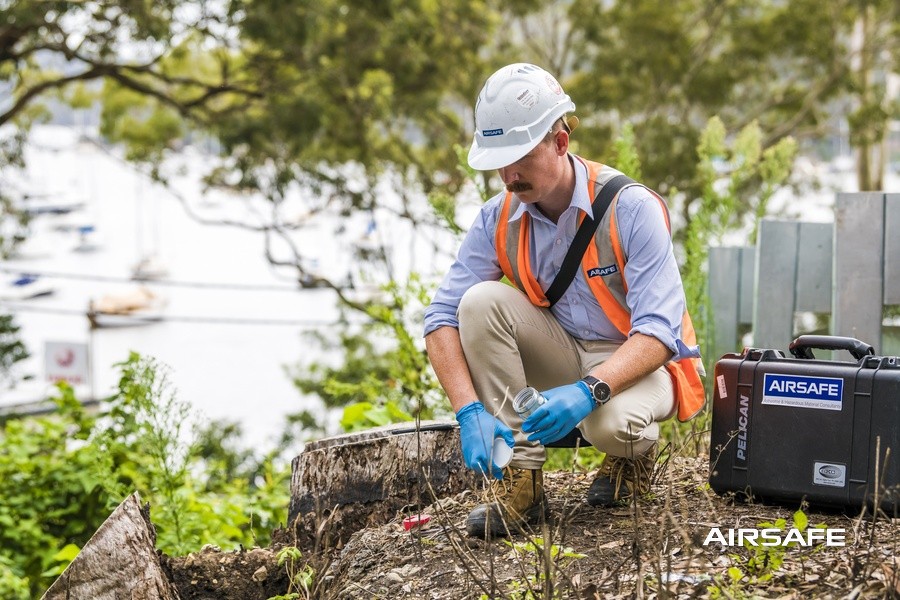
The assessor then prepares a site-specific sampling plan. Samples are recovered from the areas that need to be assessed, rather than collected at random without a purpose.
Testing of asbestos samples must be undertaken at a NATA-accredited laboratory. Airsafe identifies asbestos in its own NATA-accredited laboratory in Sydney, NATA accreditation No. 2959, by polarised light microscopy and dispersion staining in accordance with AS 4964. Airsafe’s published NATA identification scope includes non-homogeneous materials including soils.
The results are then assessed against the site use. Residential land is assessed most conservatively under the National Environment Protection (Assessment of Site Contamination) Measure.
For more detail on this work, see asbestos in soil and contaminated land assessments.
What can the response look like?
The answer depends on the form, condition and extent of the asbestos, and what the site is used for. We simply have to assess each case on its merits.
For scattered surface fragments of bonded asbestos in good condition, careful hand-picking may be suitable in limited cases. That work needs suitable work health and safety practices and should be worked to a grid so nothing is missed. On completion, no visible asbestos fragments should remain on the surface.
In other cases, the affected soil may need to be excavated and disposed of lawfully. Depending on the extent of the planned works, the whole site may have to be excavated.
A geofabric separator or capping with an ongoing management plan may provide sufficient protection in some situations. This is a site-specific decision, because soil beneath a site cannot be inspected in the same way as a wall sheet or ceiling lining.
For that reason, we’ll usually add a disclaimer to asbestos clearance certificates for sites with soil contamination, to the effect that asbestos may still be present in soil beneath the site.
Who removes it, and where can the soil go?
Airsafe does not perform asbestos removal or remediation. We find the asbestos, work out the extent, write the management or remediation approach, and validate the site once the work is done. An appropriately licensed contractor carries out the removal work, and Airsafe can help specify, tender and oversee that work.
Removing more than the equivalent of 10 square metres of bonded asbestos requires a Class A or Class B licensed asbestos removalist. Any removal of friable asbestos requires a Class A licensed asbestos removalist.
For friable asbestos removal work in NSW, only a Licensed Asbestos Assessor may undertake the air monitoring, risk assessments and clearance inspections and issue the clearance certificate. Airsafe has seven Licensed Asbestos Assessors.
All licensed asbestos removal work in NSW must have a clearance inspection, with a clearance certificate issued, before the area is reoccupied.
Asbestos-contaminated soil is classified as Special Waste (Asbestos Waste) under the NSW EPA Waste Classification Guidelines. It cannot be reused on site as clean fill and cannot be classified as virgin excavated natural material or excavated natural material. It may only be disposed of at a landfill lawfully able to receive asbestos waste.
You can’t just dump the materials anywhere you please. It is illegal to re-use, recycle or dump asbestos waste. Contaminated soil is wetted down for transport and carried in a covered, leak-proof vehicle. Loads of asbestos waste of 100 kilograms or more, or 10 square metres or more of sheeting, must be tracked through the NSW EPA’s Integrated Waste Tracking Solution.
For waste classification issues, see waste and VENM assessment.
What if the site is part of a development application?
Airsafe has been operating since 1988 and has many years of experience dealing with sites with difficult or complex contamination issues.
Where the assessment supports a development application, Airsafe contaminated-land reports are signed off by Michael Edwards, Certified Environmental Practitioner (Site Contamination Specialist).
If you have found suspect asbestos in soil, stop disturbing the area, keep it damp if safe to do so, and get expert advice before excavation continues. Call Airsafe on 1300 888 338.
Questions people ask
Is it safe to live in a house with asbestos in the garden soil?
It depends on what form the asbestos is in, its condition, how much is there, and how the area is used. The main risk is fibres becoming airborne and being breathed in, especially from dry, disturbed soil, friable asbestos or asbestos fines. Stop disturbing the area, keep it damp if safe, and get it assessed.
Can asbestos-contaminated soil be reused on site?
No. In NSW, asbestos-contaminated soil is classified as Special Waste, Asbestos Waste. It cannot be used on site as clean fill, and it cannot be classified as virgin excavated natural material or excavated natural material. It has to go to a landfill that can lawfully receive asbestos waste.