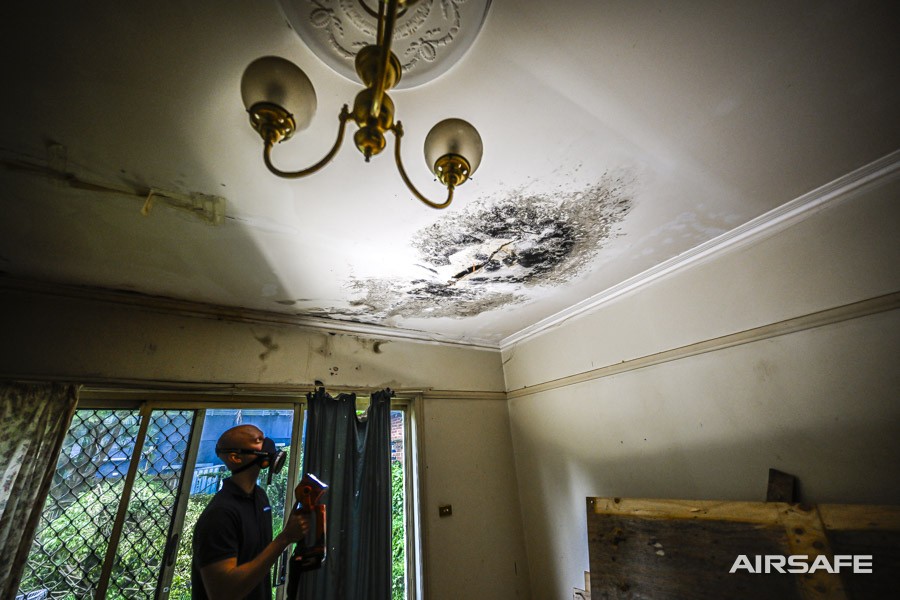
Someone cleans the mould from a bedroom wall. It disappears. A few weeks later the same black spots are back.
When that happens, start looking for water. NSW Health says mould is likely to return unless the cause of the problem is treated, and in practice that usually means finding out where the moisture is coming from and why the area is not drying properly.
Where is the moisture coming from?
Mould needs moisture to grow. Sometimes the source is obvious: a leaking roof, a burst pipe, failed waterproofing or water left behind after a flood. Sometimes it is hidden behind plasterboard, under flooring or above a ceiling, where the surface can look dry while the material behind it is still wet.
Condensation can do the same thing. Bathrooms, laundries, bedrooms with poor ventilation and rooms with cold external walls can stay damp enough for mould to return even when there is no plumbing leak. Rising damp, lateral damp and poor subfloor ventilation are other common sources.
Cleaning the visible mould does not deal with any of those things.
When is cleaning enough?
Not every patch of mould needs a consultant. A small area of surface mould caused by a one-off moisture problem that has been fixed can often be cleaned once the area is dry, then watched.
If it keeps returning, spreads over a larger area, follows a leak or flood, appears in several rooms, or there is a musty smell but not much to see, the next step is an inspection. If you’ve cleaned it twice and it is back again, assume the moisture problem is still there until you find otherwise.
One thing not to do is clean, spray or paint over the mould immediately before an inspection. Treating the surface can hide the extent of the problem and make the source harder to find.
How we work out what is happening
Testing for mould starts with an inspection, not a sample. We survey the area for odours indicating mould or bacterial growth, moisture sources such as stagnant water or leaking pipes, and water-damaged building materials. Moisture readings help us work out whether materials that look dry are still wet.
Where sampling will answer a useful question, we sample indoor and outdoor air and compare the spore concentrations, and take surface samples from areas of concern. Selected samples go to a laboratory that holds its own NATA accreditation for mould analysis. Airsafe’s own NATA accreditation does not cover mould analysis.
The Mould Inspection Report sets out where the mould is, where the moisture is coming from, what the laboratory found and what needs to be done. For a larger job, that includes a scope of works a remediation contractor can quote from.
Who fixes it, and who checks the fix?
Airsafe does not do the remediation ourselves. We work out the remedial scope separately from the cleanup contractor, so we can determine the full extent of the job.
A remediation contractor you choose carries out the work. Once it is done, we can come back and verify it with a mould clearance inspection, including moisture readings and re-sampling where appropriate. If mould is still present or materials are still wet, the report says so plainly and the contractor goes back.
A clearance certificate records the condition of the premises at the time of that inspection. If a new leak occurs later, that is a new problem rather than the old clearance somehow wearing out.
How Airsafe can help
Since 1988, Airsafe has assessed mould in homes, apartments, commercial and industrial buildings, hospitals, schools and government facilities. We are based in Sydney, but our consultants travel throughout Australia for mould inspections, testing and clearance work.
If mould has been cleaned and keeps coming back, get the source checked. Call Airsafe on 1300 888 338.