If your workers are cutting, grinding, drilling or demolishing materials that contain crystalline silica, and you can’t be certain, on reasonable grounds, that their exposure is below the workplace exposure standard, you need air monitoring. Under work health and safety regulations, that uncertainty is itself the trigger: you must arrange monitoring to find out where you stand.
In practice, that covers a lot of ordinary construction and industrial work.
What counts as silica work?
Crystalline silica is a common natural mineral found in rocks, soil and sand, and in building materials like concrete, mortar, bricks, tiles, sandstone and fibre cement sheeting. When these materials are crushed, cut, drilled, ground, sawn or polished, they generate very fine dust. Particles small enough to lodge deep in the lungs are known as respirable crystalline silica, or RCS. RCS exposure can cause silicosis, an irreversible and potentially fatal lung disease.
Work that commonly generates RCS includes:
- concrete cutting, scabbling and drilling
- demolition
- tunnelling and excavation in sandstone
- stone masonry
- blast cleaning of buildings
- manufacturing and fabrication of brick, tile, cement and stone products
Why silica still matters after the ban
Engineered stone benchtops, panels and slabs have been banned across Australia since 1 July 2024. But the ban is only on engineered stone. Other products that contain crystalline silica, including natural stone, are not banned. While the risk from working with these products is lower, it still exists and needs to be controlled. Repairs, minor modification, removal and disposal of engineered stone installed before the ban are also still permitted, and that work must be controlled and notified to SafeWork NSW in advance.
Since 1 September 2024, stronger regulations also apply to working with any crystalline silica substance, across all industries.
When does monitoring become necessary?
There are four common triggers.
You can’t be certain where you stand. This is the core duty in the Work Health and Safety Regulation: if you’re not certain, on reasonable grounds, whether the airborne concentration of silica at your workplace exceeds the exposure standard, or monitoring is needed to work out whether there’s a risk to health, you must ensure air monitoring is carried out.
The processing you do is high risk. Since 1 September 2024, if a risk assessment shows your work processing crystalline silica substances is high risk, you must have a silica risk control plan, train your workers, and use air monitoring, with results that exceed the exposure standard reported to the WHS regulator.
Something has changed. New equipment, a redesigned process, different materials or altered control measures can all invalidate old results. If the change could reasonably be expected to result in new or additional exposure, the monitoring needs to be redone.
A health monitoring report indicates an adverse result. The same applies if a substantiated complaint is raised by a worker or their representative and current air monitoring records are not available.
How silica air monitoring works
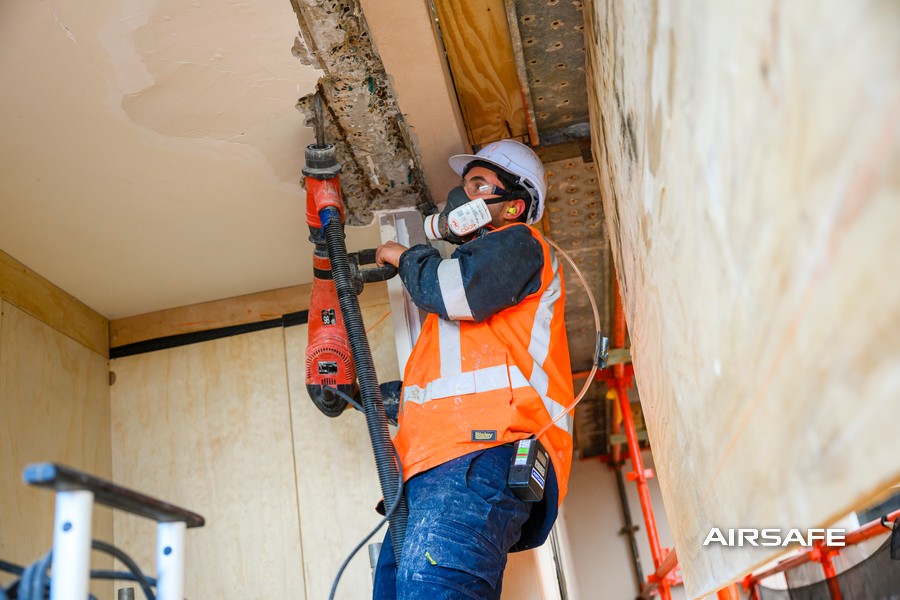
Because silica dust is breathed in where the work is done, personal exposure monitoring is the primary method. A small cyclone sampling head is clipped within the worker’s breathing zone, connected by tubing to a calibrated sampling pump worn on the belt. The cyclone separates out the respirable fraction of the dust and collects it on a filter while the worker gets on with their normal tasks over a representative period of the shift. Sampling is carried out in accordance with the relevant Australian Standard, AS 2985.
Airsafe takes the samples on site under our NATA accreditation for volume measurement, then sends the filters to a separately NATA accredited laboratory for analysis. The result comes back as a concentration in milligrams per cubic metre, which is compared against the workplace exposure standard for respirable crystalline silica: 0.05 mg/m3 as an eight-hour time weighted average. From 1 December 2026, the workplace exposure standards become workplace exposure limits, and the RCS figure carries through unchanged.
What if the results are too high?
If you’re in charge of a workplace, you have a legal responsibility to ensure your workers are not exposed to silica above the exposure standard. If the results are over the limit, we advise you on the best course of action to control people’s exposure, following the standard hierarchy of controls: eliminating activities that generate silica dust where possible, substituting materials, wet suppression, on-tool extraction and ventilation, then administrative controls and respiratory protection for any worker who may still be exposed. For high-risk silica processing, results over the standard must also be reported to the WHS regulator. Once controls are improved, monitoring is repeated to confirm they’re working.
Note that even concentrations below the exposure standard can potentially be a health hazard. For that reason, work health and safety regulations require that exposure to airborne contaminants be kept as low as is reasonably practicable.
How does health monitoring fit in?
Air monitoring measures what’s in the air. Health monitoring checks the worker’s health for early signs of disease, through things like lung function testing and chest imaging. If your workers are at significant risk from silica exposure, and whenever the processing is high risk, you must provide health monitoring as well. NSW also now runs a Silica Worker Register: workers carrying out high-risk crystalline silica processing must be registered with SafeWork NSW within 28 days of starting that work.
How Airsafe can help
Since 1988, Airsafe has run respirable crystalline silica monitoring programs for builders, demolition contractors, tunnellers, fabricators, mining, manufacturing and government across Sydney, NSW and Australia. The sampling pumps and cyclones we bring to site are our own, and most silica monitoring jobs we do run alongside inhalable dust, diesel particulate or noise monitoring as a single integrated program.
If you need workplace monitoring for crystalline silica, learn more on our respirable crystalline silica monitoring page, or call Airsafe today on 1300 888 338.
Questions people ask
What is the exposure limit for respirable crystalline silica in Australia?
The workplace exposure standard for respirable crystalline silica is 0.05 mg/m3, measured as an eight-hour time weighted average. From 1 December 2026, workplace exposure standards become workplace exposure limits, and the RCS figure stays the same.
What are the requirements for silica testing in a workplace?
Silica air monitoring is carried out as personal exposure monitoring. A cyclone sampling head sits in the worker’s breathing zone, connected to a calibrated pump, while normal work continues for a representative part of the shift. Sampling is done to AS 2985, then the filter is analysed and reported as a concentration.
Does Airsafe analyse the silica samples itself?
No. Airsafe collects the samples on site, with flow rates and air volumes measured under Airsafe’s NATA accreditation. The filters are then sent to an external NATA-accredited laboratory for silica analysis. The result is reported in milligrams per cubic metre and compared with the exposure standard.
How often does silica monitoring need to be repeated?
There is no fixed calendar interval. Monitoring needs to be redone when changes to equipment, materials, processes or controls could create new or additional exposure. If controls are improved after results are over the limit, monitoring is repeated to check those controls are working.
Are real-time silica monitors used?
For RCS, Airsafe uses gravimetric personal sampling. A cyclone and pump collect the respirable fraction onto a filter, then the filter goes to an external NATA-accredited laboratory for analysis. The result comes back as a concentration that can be compared with the exposure standard.