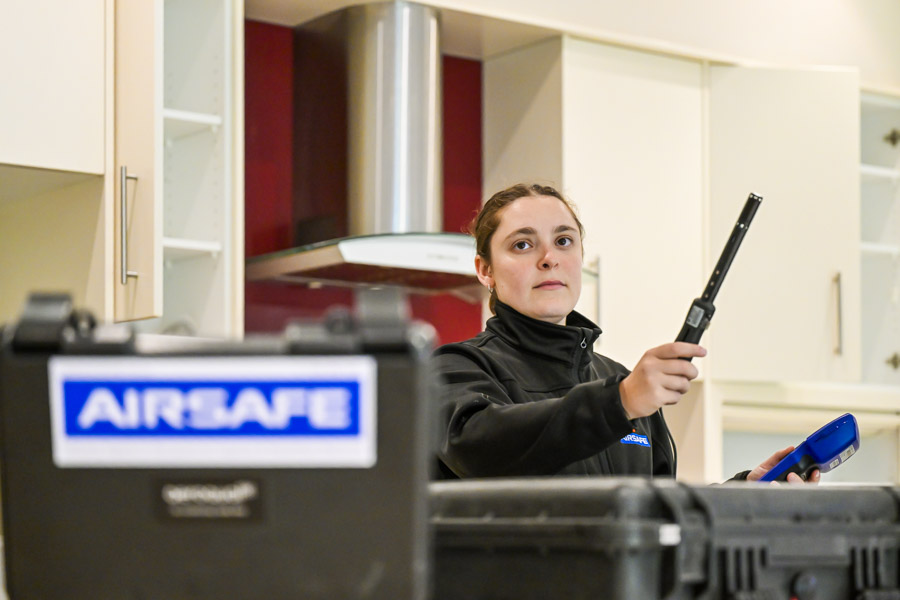
When you bring Airsafe in, an occupational hygienist visits your site, works out where VOCs are likely to be coming from – fit-outs, processes, products in use – and collects air samples for laboratory analysis. You get a clear report on what was found and whether the relevant exposure standards are being exceeded, with practical recommendations if they are.
Volatile organic compounds: what are they?
Everywhere we go, we’re surrounded by volatile organic compounds. VOCs are chemicals that turn to vapour at normal room temperature – unlike substances with a higher boiling point, like water. They’re very common, created by both the natural world (biogenic VOCs) and human activity (anthropogenic VOCs).
And VOCs aren’t all bad. In the natural world they play an important role in communication between animals and plants; in the human world they’re used in plenty of household products, and they’re what makes perfume smell good.
They’re also generated in industrial settings, including:
- fossil fuel use and production
- solvents used in coatings, paints and inks
- compressed aerosol products such as butane and propane
- biofuels used in some parts of the world
- biomass combustion, especially from rainforests.
Outdoor and indoor exposure to VOCs
VOCs affect air quality both outdoors and indoors – we all breathe in VOCs outdoors from car exhaust, for instance. But levels indoors can be much higher: typically two to five times higher than outdoors, sometimes more.
Concentrations are often particularly high in new buildings, through the process known as off-gassing, where new building materials, fittings, floor coverings, glues, paints and sealants give off a cocktail of VOCs. That makes proper ventilation especially important when you move into a new home or premises.
New buildings aren’t the only source, though. Everyday workplace activities produce VOCs too – one of the most common being office printers and photocopiers. A gas stove in the workplace is another potential source. And smoking generates VOCs on top of all its other health effects, which is one more reason to enforce workplace smoking bans.
Health effects of VOCs
Not all exposure to VOCs is harmful, but in recent years there’s been rising concern about the health effects of excessive exposure to some of them.
It’s common to experience irritation, or an allergic or immune reaction, to VOCs. Symptoms can range from irritation of the eyes, nose and throat to headaches, loss of coordination, nausea, and damage to the liver, kidneys or central nervous system. Certain VOCs are also associated with cancer.
How Airsafe monitors VOCs
Airsafe’s occupational hygienists are experts at measuring VOC concentrations in indoor environments. We usually start with a general screen that can identify around 60 different VOCs. If you’re in a high-risk industry or carrying out particular kinds of work, we can also do more focused monitoring for specific VOCs.
Airsafe is accredited by NATA for volume measurement, so we collect the samples on site using NATA-accredited equipment, then send them to a dedicated NATA-accredited analysis laboratory. All our test reports carry metrological traceability.
VOCs and exposure standards
There are guidelines for total VOCs (TVOCs), but in practice the exposure standards that matter most in the workplace are the ones that apply to individual chemicals that are particularly hazardous. Whatever the relevant standards, our air monitoring reports give you a definitive answer about whether they’re being exceeded. We’ll advise you on which standards apply to your situation and monitor against them, so you can show you’re meeting your work health and safety obligations.
Not sure which standards apply to your workplace? Call Airsafe on 1300 888 338 and we’ll talk it through, or contact us for a fast quote.
Protecting your workers from VOCs
-
There are general steps you can take to minimise your workers’ exposure to potentially hazardous VOCs. The American Lung Association recommends two measures in particular: avoiding or limiting use of products with high VOCs, and adding ventilation when you use products with VOCs indoors.
To avoid or limit the use of products with high VOCs, you can:
- use products that are specifically designed to be low in VOCs (see below)
- where possible, eliminate work practices that use VOCs
- buy only as much as you need, and dispose of leftover or unused products safely
- always follow the manufacturer’s directions.
Specific advice around ventilation includes:
- opening windows and using a fan to pull indoor air outside
- airing carpets and new building products outside to allow them to de-gas before installing them
- not storing products with VOCs indoors, including in garages
- test ventilation systems to make sure they are working effectively.
-
One way in which industry can help minimise exposure of workers and others to VOCs is by using low-VOC products. In particular, there are a number of paints available which are accredited as low-VOC according to the Australian Paint Approval Scheme. There are also paints available which are completely VOC-free.
A good way to find low-VOC paints is using the Sensitive Choice program run by the National Asthma Council. The program’s website lists a number of approved paints, one of the criteria for approval being the use of low-VOC formulas.
The website Architecture and Design also has a guide to Eight of Australia’s best low and zero VOC paints, including products from household name paint brands as well as niche companies that specialise in environmentally responsible products.
Why choose Airsafe?
Airsafe is one of Australia’s most respected occupational hygiene consultancies. As our name implies, air quality monitoring is one of our core activities – we have the equipment and the expertise to monitor for a wide range of airborne contaminants, VOCs among them.
We own our monitoring equipment outright rather than hiring it – including handheld instruments that give on-the-spot VOC readings – so there’s no waiting on hire gear before we can get to site, and everything is calibrated on our own schedule.
VOCs rarely turn up on their own. A new fit-out, a print room or an industrial process can throw off dust, silica, welding fume, carbon monoxide and other dangerous gases and hazardous chemicals alongside them. Rather than dealing with each one in a piecemeal manner, you’re better off with a holistic approach – and with the same team able to assess the lot in one engagement, you’re not left coordinating several consultants for one site.
4.9 stars from over 640 Google reviews and counting, from manufacturers, builders, contractors and industrial clients across Australia.
AIRSAFE has become our go-to company for all air monitoring needs. Working for a large paint company, we’ve found their service not only exceptional but also backed by valuable advice. They are consistently reliable, flexible, and a pleasure to work with. These qualities made it an easy decision to choose them as our preferred supplier.
Nik Pappas, November 2025
We recently appointed Airsafe to undertake air monitoring and reporting at a brownfield development site during the demolition stage. Their proactive, professional and cost and time-efficient approach and implementation were excellent.
Carl O. Peterson, December 2021
I use Airsafe on a regular basis for commercial construction. Liam Matthews and the Airsafe team always get the job done professionally, safely, and in a prompt manner as required. If only I could give more stars.
Jordan Kissane, September 2021
Frequently asked questions
-
Volatile organic compounds are chemicals that turn to vapour at normal room temperature. They’re everywhere – created both by nature and by human activity – and not all of them are harmful. In a workplace, the ones worth thinking about come from things like solvents, paints, inks and adhesives, fuels and aerosols, office printers and photocopiers, gas appliances, and the off-gassing of new building materials and furniture. New fit-outs are a particularly common source.
-
Some are, in high enough concentrations. Exposure commonly causes irritation of the eyes, nose and throat, and can lead to headaches, loss of coordination and nausea; longer-term, some VOCs can affect the liver, kidneys or central nervous system, and certain VOCs are associated with cancer. Indoor levels matter most, because they’re often two to five times higher than outdoors – higher still in new buildings. The point of monitoring is to find out which VOCs you actually have and at what levels, so you’re not guessing.
-
We usually start with a general screen that picks up around 60 different VOCs, which tells us what’s present in your indoor environment. If you’re in a high-risk industry, or doing particular work that generates a known VOC, we can run more focused monitoring for that specific compound. We collect the samples on site under our NATA accreditation for volume measurement, then have them analysed by a dedicated NATA-accredited laboratory, so the results carry metrological traceability. Either way, you get a clear report on what was found and how it compares against the relevant exposure standards.
-
There are guidelines for total VOCs, but in practice the standards that matter most are the ones set for individual chemicals that are particularly hazardous. We’ll work out which apply to your situation and monitor against them – and whatever the relevant standards, our reports give you a definitive answer about whether they’re being exceeded. (Note that the workplace exposure standards become workplace exposure limits from December 2026.) Just call us on 1300 888 338 if you’d like to talk through which ones apply to you.
-
Yes, and it’s usually the sensible way to do it. VOCs rarely turn up on their own – a new fit-out or an industrial process tends to bring dust and other contaminants with them. With our holistic approach to occupational hygiene, the same team can assess all of it in one go, so you’re not coordinating several consultants for one site. Just call us on 1300 888 338 to talk through what your workplace needs.
Contact us about VOCs today
Airsafe can set your mind at rest about VOC exposure with comprehensive risk assessment, monitoring and clear advice on what, if anything, needs to change. We work across Sydney, NSW and Australia, with travel built into our quotes for sites further afield.
If you’re concerned about VOCs in your workplace, contact us for a fast quote, or call Airsafe on 1300 888 338.
Last updated: August 2026